Christian Venturella

I am a PhD student in theoretical chemistry at Yale, where I am advised by Tianyu Zhu. I am an NDSEG fellow working for the Office of Naval Research to develop new methods for predicting excited-state properties of materials.

Before starting my PhD, I did my undergrad at Princeton, where I worked with Greg Scholes for my senior thesis.

Christian Venturella

Research

I’m interested in quantum chemistry, materials science, and artificial intelligence, with a focus on developing efficient and accurate methods for predicting many-electron properties beyond standard DFT. My work aims to bring together modern machine learning approaches with traditional physical chemistry to address challenges in spectroscopy, materials science, and catalysis.

Paper Thumbnail

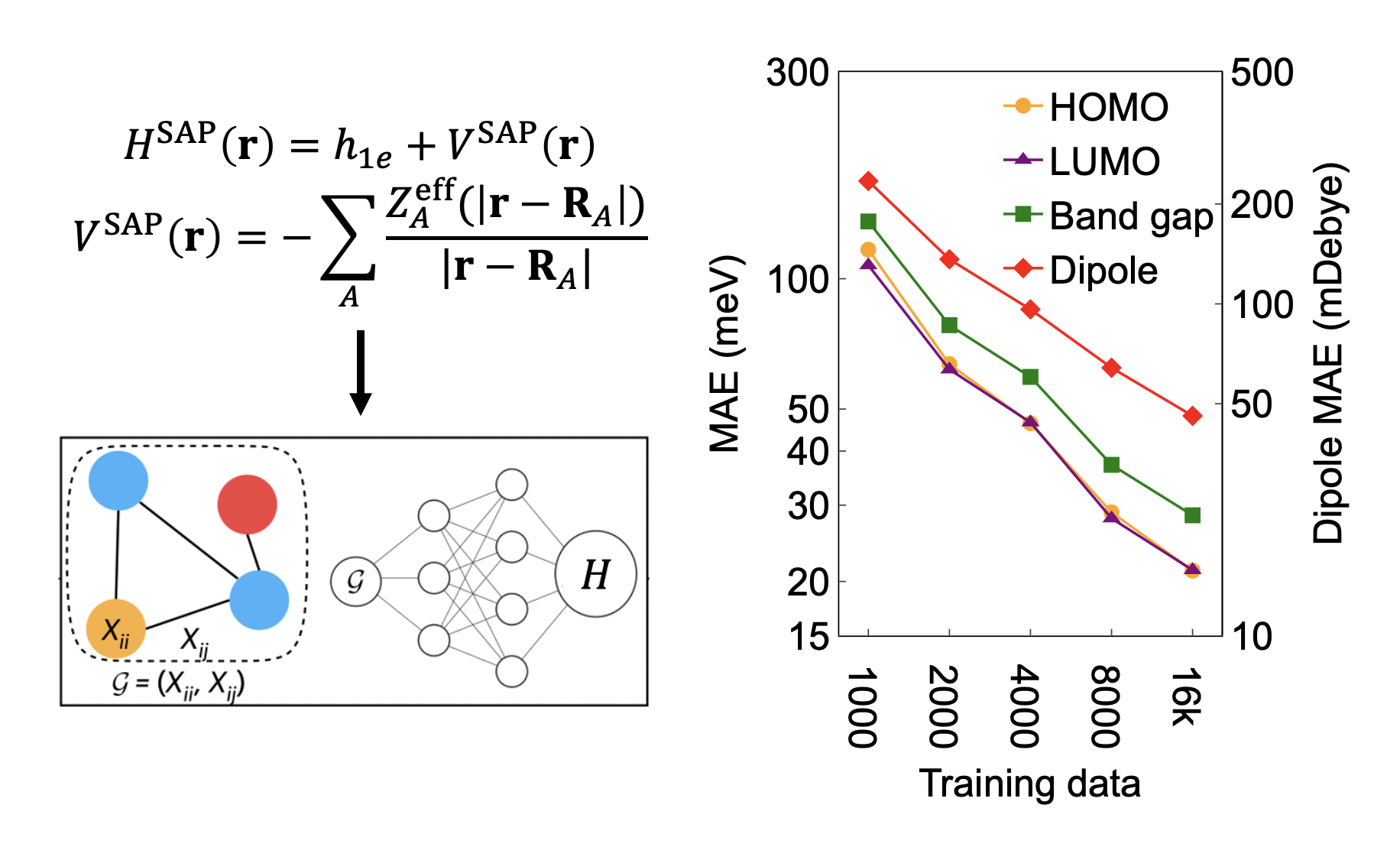
Transferable Machine Learning of Electronic Hamiltonians with Superposition-of-Atomic-Potentials Features

Chaoqun Zhang†, Christian Venturella†, Enzhi Chen, Tianyu Zhu*
arXiv 2026, 2026

Low-cost orbital descriptors enable DFT Hamiltonian learning with high accuracy and efficiency. Downfolding large basis sets enables distillation of the low energy spectrum. Applications to QM9 molecules and tight binding models of intermolecular charge transfer are presented.
Paper Thumbnail

Low-Scaling Many-Body Green's Function Calculations for Molecular Systems via Interacting-Bath Dynamical Embedding Theory

Christian Venturella, Jiachen Li, and Tianyu Zhu*
arXiv 2026, 2026

We present a molecular extension of a recently proposed Green’s function embedding method, interacting-bath dynamical embedding theory (ibDET), for computing charged excitation energies at the GW and EOM-CCSD levels.

Paper Thumbnail

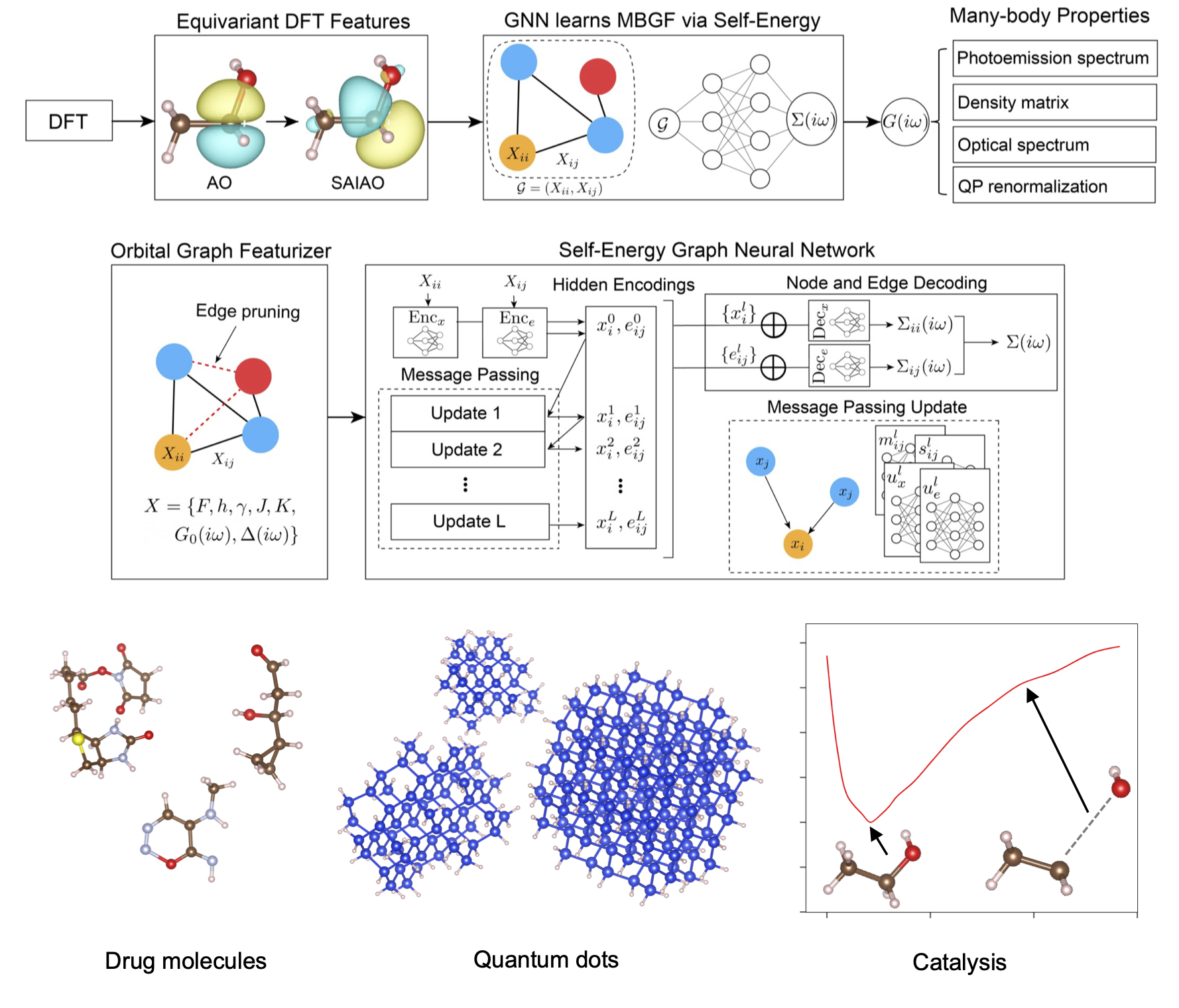
Unified Deep Learning Framework for Many-Body Quantum Chemistry via Green's Functions

Christian Venturella, Jiachen Li, Christopher Hillenbrand, Ximena Leyva Peralta, Jessica Liu, Tianyu Zhu*
Nature Computational Science, 2025

A deep learning framework that unifies ground and excited state property prediction by targeting the many-body Green’s function (MBGF) and self-energy. I design and implement a graph neural network called MBGF-Net that learns the underlying physics to derive properties with competitive accuracy, unprecedented data efficiency, and impressive transferability and generalizability.

Paper Thumbnail

Machine Learning Many-Body Green's Functions for Molecular Excitation Spectra

Christian Venturella, Christopher Hillenbrand, Jiachen Li, and Tianyu Zhu*
J. Chem. Theory Comput. 2024, 2024

A machine learning method for predicting many-body Green’s Functions for realistic molecules and materials.